
Stop guessing which foods are the problem
Looking for an MRT food sensitivity test in Austin? Nuvitru offers testing at our Lakeway clinic and collection kits for patients nationwide, with practitioner guidance available separately.
Bloating after meals. Headaches that come out of nowhere. Joint aches, skin flares, brain fog, or fatigue that never quite lifts. You suspect food is part of it, but you have cut out gluten, dairy, and half your pantry, and you still do not have a clear answer.
This is exactly where food sensitivity testing can help. The MRT, or Mediator Release Test, shows how your immune cells react to 176 foods and food chemicals, so your elimination plan is guided by data instead of guesswork.
You do not have to live in Austin to take this test
In Austin and Lakeway
we draw your blood right in our clinic in Lakeway.
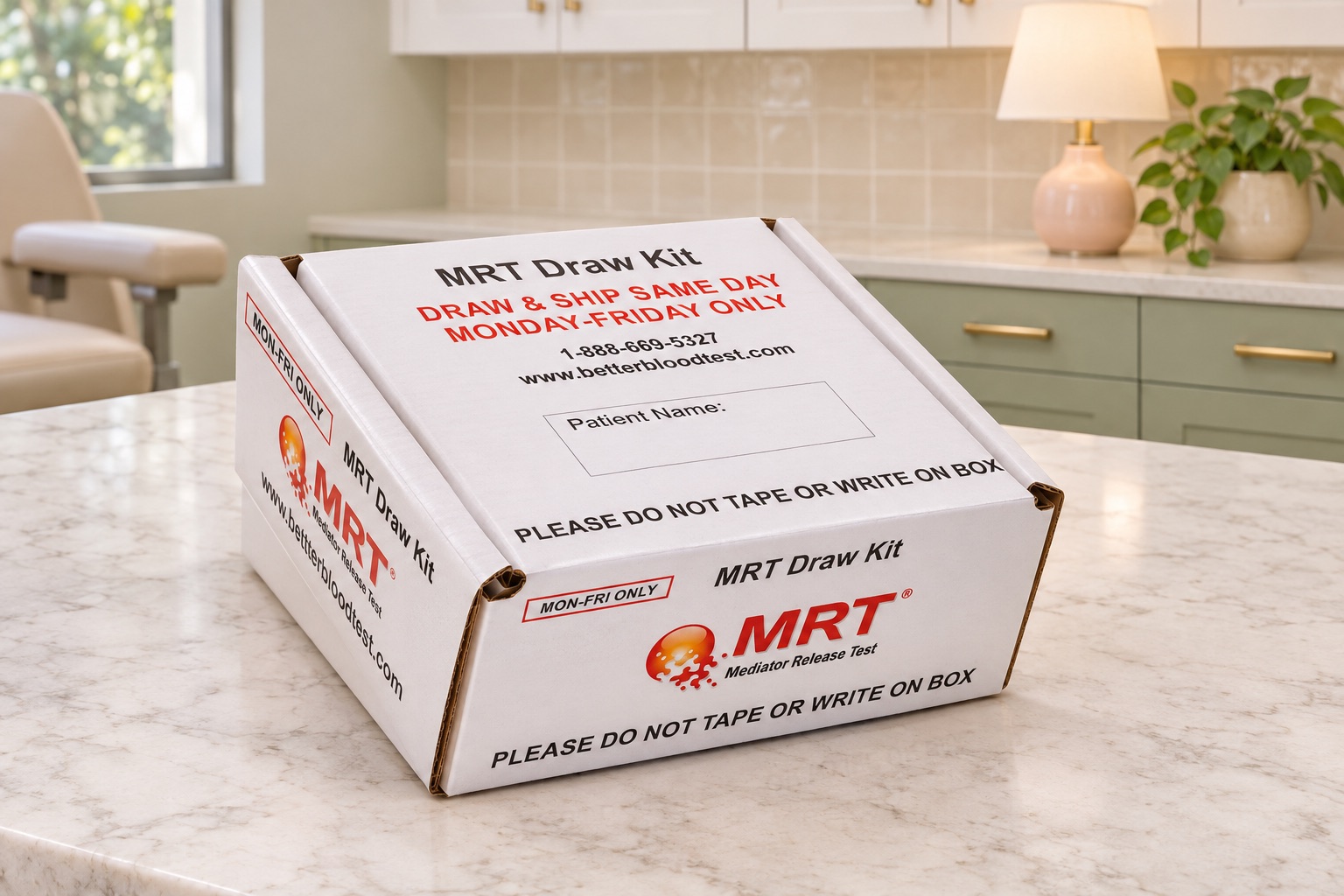
Nationwide collection kits
we ship a collection kit to you, and you complete your blood draw near home.
Either way, your results come back to your Nuvitru patient portal, and our team can help you turn them into a plan.
Food allergy, sensitivity, or intolerance?
These words get used interchangeably, but they are very different things.
| Type | What happens | How fast | How it is evaluated |
|---|---|---|---|
| Food allergy | An immune reaction that may involve IgE antibodies and cause hives, swelling, or anaphylaxis | Often within minutes | Clinical history, targeted IgE or skin testing, and sometimes a supervised food challenge |
| Food sensitivity | A broad term used for suspected reactions to foods; MRT measures blood-cell responses in a sample | Symptoms may be delayed and vary | Clinical assessment and guided elimination and reintroduction; MRT does not establish a diagnosis |
| Food intolerance | Difficulty digesting a food, such as lactose intolerance | Often within hours | Symptom history, breath testing when appropriate, or guided elimination |
The MRT is not an allergy test. If you have ever had a severe or fast reaction to a food, like swelling, trouble breathing, or hives, that needs to be evaluated as a possible allergy. We also offer food allergy testing at Nuvitru for exactly this reason.
Signs you may have food sensitivities
Because sensitivity reactions are delayed, they are hard to connect to a specific food. Common signs include:
- Bloating, gas, diarrhea, constipation, or IBS-type symptoms
- Headaches or migraines
- Joint or muscle aches
- Eczema, acne, or other skin flares
- Brain fog and fatigue
- Congestion or postnasal drip
- Feeling worse even when you are eating "healthy"
How the MRT food sensitivity test works
The MRT is run by Oxford Biomedical Technologies. It looks at what happens when your white blood cells are exposed to each food and food chemical on the panel.
When your immune cells react to something, they release inflammatory chemicals called mediators, things like histamine, cytokines, and prostaglandins. As they release them, the cells change in size. The MRT measures that change, which reflects how strongly your immune cells reacted.
Why this is different from IgG testing
Many food sensitivity tests only measure IgG antibodies, which is just one way the immune system can respond to food. MRT measures changes in blood-cell volume after exposure to foods and chemicals; the laboratory uses these changes as an indirect measure of reactivity. It also tests food chemicals and additives, like food dyes and preservatives, which IgG tests do not.
What your results look like
Each food is sorted into one of three categories:
Green
non-reactive in the laboratory sample. This is not a diagnosis of allergy or a guarantee of food tolerance.
Yellow
moderately reactive in the laboratory sample. This is not a diagnosis of allergy or a guarantee of food tolerance.
Red
reactive in the laboratory sample. This is not a diagnosis of allergy or a guarantee of food tolerance.
The color-coded report can inform a discussion about a supervised elimination plan. It does not tell us which foods are safe or prove which foods cause your symptoms.
Step by step: from ordering to results
Order your test through the Nuvitru shop.
Get your blood drawn
In Austin, we do it in our Lakeway clinic. Outside of Austin, we ship you a kit and you complete your draw locally.
The lab runs your sample
Results usually come back 2–3 days after the lab receives it.
Results land in your patient portal, and we let you know they are ready.
Review them with a practitioner, so your results become a real plan.
What happens after your results come back
The report is only the beginning. A list of red and yellow foods does not heal anything on its own. What you do with it is what matters.
A guided elimination phase
We build your meals around your green foods and temporarily remove your reactive ones. This gives your immune system and gut a chance to calm down. Many people notice changes in bloating, energy, skin, or headaches within the first few weeks.
Structured reintroduction
Foods are brought back one at a time, in a specific order, while you track how you feel. This is the step most people skip when they DIY an elimination diet, and it is where the most useful information comes from. The goal is the most varied diet your body tolerates, not a permanently short food list.
Looking at the root cause
Food-related symptoms can have many causes, including digestive conditions, food intolerance, medication effects, and stress. A test result alone cannot establish gut inflammation, microbiome disruption, or increased intestinal permeability.
That is why we often pair MRT results with other testing, like a comprehensive stool test, to understand why your body became reactive in the first place. Additional testing should be chosen for your symptoms and history rather than assumed to be necessary for everyone.
If people want to tackle one thing at a time, I recommend a stool test over the MRT as a starting point.
Making sure you stay nourished
Removing foods can create nutrient gaps if it is not done thoughtfully. Our dietitians make sure your plan still gives you enough protein, fiber, and key nutrients while you heal.
MRT food sensitivity test Austin: cost and what is included
The MRT food sensitivity test is $550 at Nuvitru. That price covers the lab test itself.
What is included
- Testing for 176 foods and food chemicals through Oxford Biomedical Technologies
- Your collection kit and step-by-step instructions
- In-clinic blood draw if you are in Austin
- Results uploaded to your patient portal, with a text when they are ready
What is separate
- Interpretation and your eating plan. Results become most useful when you review them with a practitioner. You can add a new patient session or join a care plan to build your elimination and reintroduction plan.
- Your blood draw outside of Austin. If we ship your kit, the cost of having your blood drawn locally is not included in the test price.
Nuvitru does not bill insurance for lab testing.
Is the MRT right for you?
The MRT may be a good fit if:
- You have ongoing digestive, skin, headache, or joint symptoms you suspect are tied to food
- You have tried cutting foods on your own without clear answers
- You want data before starting an elimination diet
- You are ready to follow a plan and review your results with a practitioner
It may not be the right first step if you have had a fast or severe reaction to a food, which needs allergy testing, or if you need urgent care.
Ready to stop guessing? Order your MRT food sensitivity test here. We ship kits nationwide, and Austin patients can have their blood drawn right in our clinic.
Frequently asked questions
How much does an MRT food sensitivity test cost in Austin?
At Nuvitru, the MRT food sensitivity test is $550 for the lab test, which covers 176 foods and food chemicals. Austin patients have their blood drawn in our Lakeway clinic. Interpretation and a personalized eating plan are available separately.
Can I do the MRT test if I don't live in Austin?
Yes. Nuvitru ships MRT collection kits nationwide. You complete your blood draw locally, the sample goes to the lab, and your results are uploaded to your patient portal.
How long do MRT results take?
Results usually come back 2–3 days after the lab receives your sample.
Is the MRT a food allergy test?
No. The MRT looks at delayed, non-IgE food sensitivity reactions. Fast or severe reactions like hives, swelling, or trouble breathing need allergy testing.
What is the difference between MRT and IgG food sensitivity tests?
IgG tests measure one type of antibody. The MRT measures how much inflammatory chemicals your white blood cells release when exposed to each food, and it also tests food chemicals and additives.
What do I do after I get my MRT results?
Work with a practitioner to build a guided elimination and reintroduction plan, and look for the root cause of your sensitivities, which is often gut related.
This article is for educational purposes and is not a substitute for individualized medical advice. The MRT does not diagnose or treat any condition.