

A period is not proof of ovulation
Most women assume that if they get a period every month, they are ovulating every month. It makes sense. But it is not always true.
You can bleed without ovulating. These are called anovulatory cycles, and they are more common than most women realize. Every woman has one now and then, but when they happen regularly, they quietly make getting pregnant much harder.
In my eleven years in women's health, I have worked with so many women who were told their cycles looked "normal" and kept trying for months, without anyone ever confirming they were releasing an egg.
The good news is that you can find out. Between your body's own signals, wearables like the Oura ring, and at-home hormone testing like Mira, you have more ways than ever to see what is actually happening in your cycle.
What ovulation actually is
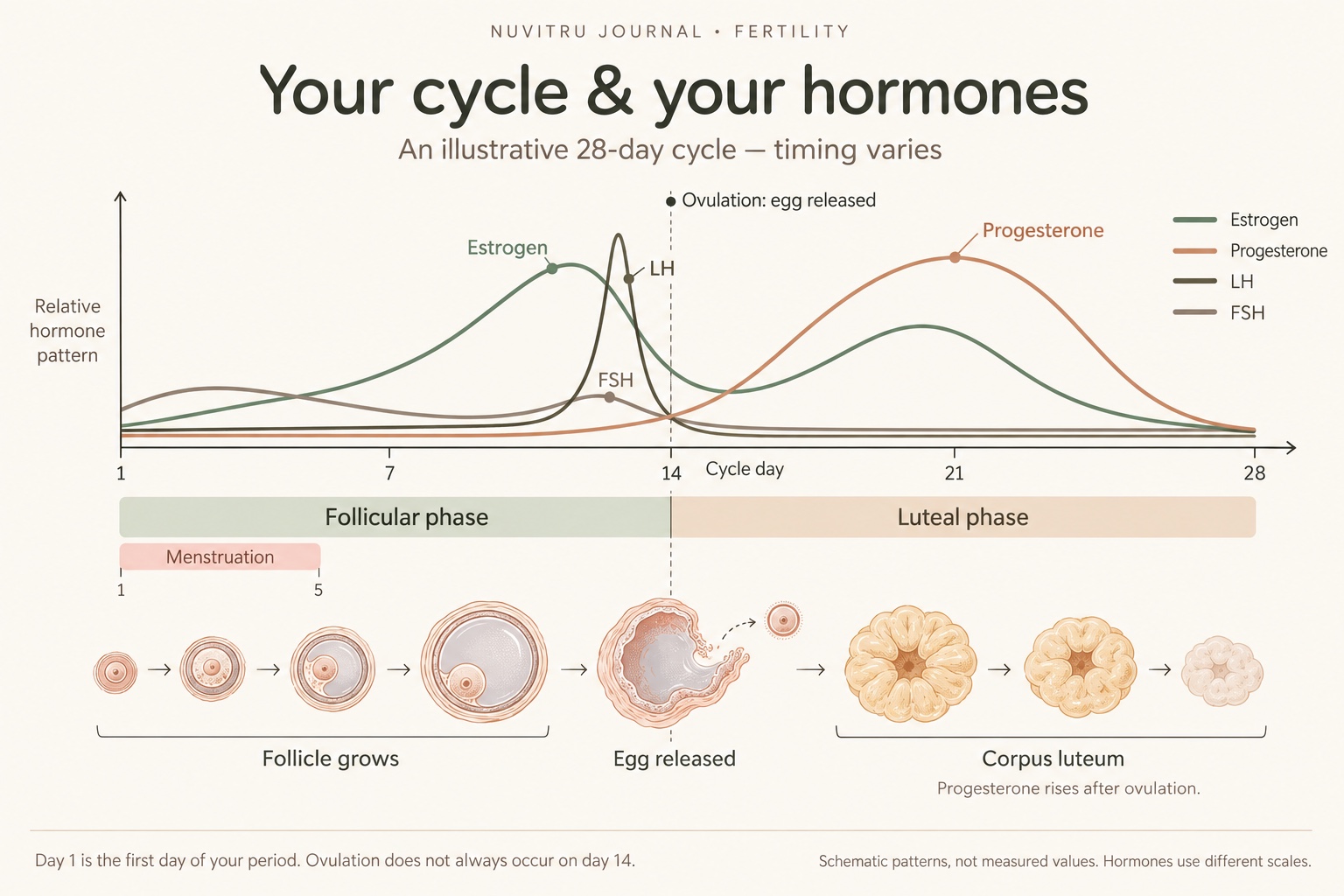
Ovulation is the moment your ovary releases a mature egg. Everything in your cycle is building toward it.
Here is how it works:
- The follicular phase. Early in your cycle, your brain sends FSH (follicle stimulating hormone) to your ovaries. That signal grows a few follicles, the small fluid-filled sacs that hold your eggs. One becomes the lead follicle.
- Estrogen rises. As that follicle grows, it makes more and more estrogen. Estrogen thickens your uterine lining and creates fertile cervical mucus.
- The LH surge. When estrogen peaks, your brain releases a burst of LH (luteinizing hormone). This surge is the trigger. Ovulation usually follows within about 24 to 36 hours.
- The egg is released. The follicle ruptures and releases the egg, which lives for about 12 to 24 hours.
- The luteal phase. The empty follicle turns into the corpus luteum, a temporary gland that makes progesterone. Progesterone keeps your uterine lining stable and ready for implantation.
That last step is the key to this whole conversation. Progesterone is only made in meaningful amounts after you ovulate. So the most reliable signs of ovulation all point back to one thing: a rise in progesterone after the LH surge.
The signs your body gives you
Your body leaves clues around ovulation. None of them confirm it on their own, but together they tell a story.
- Cervical mucus. As estrogen rises, mucus becomes clear, slippery, and stretchy, often compared to raw egg whites. This is your most fertile window. After ovulation, progesterone dries it up and makes it thicker or sticky.
- Ovulation pain. Some women feel a twinge or dull ache on one side of the lower abdomen around ovulation. It has a name, mittelschmerz, which is German for "middle pain."
- Higher libido. Many women notice a natural rise in desire right before ovulation, driven by estrogen and a small bump in testosterone.
- Breast tenderness after ovulation. Rising progesterone in the luteal phase can make breasts feel full or sore.
These signs are worth paying attention to. But fertile mucus shows that your body is preparing to ovulate, not that it actually did. For that, we need data.
Using your Oura ring to track ovulation
If you already wear an Oura ring, you are collecting useful cycle data every night. Here is what it is actually picking up.
Temperature
Progesterone is a warming hormone. After ovulation, it raises your resting body temperature by roughly 0.3 to 0.5°F, and that higher temperature holds through the luteal phase until your period. This is the same principle behind traditional basal body temperature (BBT) charting.
The difference is how it is measured. Oral BBT requires taking your temperature at the same time every morning before you get out of bed, which is easy to get wrong. Oura measures your skin temperature continuously while you sleep and compares it to your own baseline, so you get a cleaner trend with no thermometer.
What you are looking for is a clear shift: lower temperatures in the first half of your cycle, then a sustained rise that stays up for the rest of the cycle. Oura's cycle features use this pattern to estimate when you ovulated.
Resting heart rate and HRV
Oura also tracks resting heart rate and heart rate variability (HRV), a measure of how adaptable your nervous system is. In the luteal phase, many women see resting heart rate creep up and HRV dip slightly. That shift is another clue that progesterone is on board.
What Oura can tell you
- Whether your temperature shifted, which suggests ovulation happened
- Roughly when it happened
- How long your luteal phase is. Count the days from your temperature rise to your next period. A luteal phase shorter than about 10 days can be a sign of low progesterone.
Where Oura falls short
- It looks backward. Your temperature rises after ovulation. By the time you see the shift, your fertile window has usually closed. It is great for confirming patterns over time, not for timing in the moment.
- It does not measure hormones. A temperature shift tells us progesterone rose. It does not tell us how much, or whether it was enough to support implantation.
- Life gets in the way. Alcohol, illness, travel, late meals, and poor sleep can all throw off your temperature data.
- It needs time. Give it at least two to three cycles to learn your baseline before drawing conclusions.
Oura is a fantastic foundation. When you are trying to conceive, though, we want to see the hormones themselves.
Why we use Mira hormone testing
Mira is an at-home hormone monitor that reads urine test wands and gives you actual hormone numbers. Not a faint line you have to squint at. Real values you can track day by day.
Depending on the wand, Mira measures:
- FSH, which shows how hard your brain is working to recruit a follicle
- E3G, an estrogen metabolite that rises as your follicle grows and signals your fertile window opening
- LH, the surge that triggers ovulation
- PdG, a progesterone metabolite that rises after ovulation
PdG is the confirmation
This is the piece that matters most. A positive LH test tells you your body tried to ovulate. A sustained rise in PdG afterward tells you it actually did.
Those are not always the same thing. Some women surge LH, sometimes more than once, without a follicle ever releasing an egg. This is especially common with PCOS, high stress, and in the months after coming off birth control. A standard ovulation strip would read positive in every one of those cycles.
Why it beats guessing
Because Mira gives us numbers, we can see the whole shape of your cycle:
- When your fertile window truly opens, days before the LH surge, so you can time intercourse well
- Whether estrogen rises steadily or struggles to build
- Whether LH surges once, cleanly, or several times
- Whether progesterone rises after ovulation and stays elevated through the luteal phase
That last point tells us not just whether you ovulated, but how well. A weak or short-lived progesterone rise can point to egg quality or luteal phase issues we would want to address before you conceive.
This is why Mira hormone tracking is part of our 12-Week Fertility Program at Nuvitru. We review your Mira data alongside your labs, so your plan is based on what your hormones are actually doing.
Other ways to confirm ovulation
LH ovulation strips
These are the drugstore tests most women start with. They detect the LH surge and are helpful for timing. The limitation is the same one we covered above: they show that LH surged, not that you released an egg. Women with PCOS often have higher baseline LH, which can cause confusing or repeated positives.
Mid-luteal progesterone blood test
This is a simple blood draw taken about seven days after you ovulate, when progesterone should be at its peak. In a 28-day cycle, that is usually around day 21, which is why you may hear it called a "day 21 progesterone."
The catch is timing. If your cycles are longer or shorter than 28 days, day 21 may be the wrong day, and the result can look low even if you ovulated. This is where tracking with Mira or Oura helps us time the draw correctly. A progesterone level above about 3 ng/mL generally suggests ovulation happened, though many clinicians, myself included, like to see a much stronger number to support implantation.
Ultrasound follicle tracking
This is the most direct method. A series of transvaginal ultrasounds watches a follicle grow and then collapse after it releases the egg. It is typically done in fertility clinics, especially during treatment cycles, because it requires several appointments in a short window.
How the methods compare
| Method | What it tells you | Confirms ovulation? | Best for |
|---|---|---|---|
| Cervical mucus | Estrogen is rising; fertile window is open | No | Free, daily awareness of your fertile window |
| LH strips | LH surged | No | Simple timing of intercourse |
| Oura ring | Temperature rose after ovulation; luteal phase length | Suggests it, after the fact | Spotting patterns across many cycles |
| Mira | FSH, estrogen, LH, and progesterone levels in real time | Yes, with a sustained PdG rise | Full picture of your cycle and hormone quality |
| Progesterone blood test | Progesterone level at one point in the luteal phase | Yes, if timed correctly | Lab confirmation of ovulation and progesterone strength |
| Ultrasound tracking | Follicle growth and release | Yes, most directly | Fertility treatment cycles |
The most complete picture comes from combining them. My favorite pairing is Oura for the nightly trend and Mira for the hormone data, with a well-timed progesterone blood test to back it up.
Signs you may not be ovulating
Pay attention if you notice:
- Cycles shorter than 21 days or longer than 35 days
- Cycles that vary a lot from month to month
- No clear temperature shift on Oura across several cycles
- LH positives with no PdG rise afterward on Mira
- Never seeing fertile, egg-white cervical mucus
- Very light, very heavy, or missing periods
- Spotting before your period, which can point to low progesterone
What can get in the way
Ovulation is sensitive. Your body only releases an egg when it feels safe and well resourced. Common reasons it does not happen:
- PCOS, often driven by insulin resistance and higher androgens
- Thyroid imbalances, including Hashimoto's
- High prolactin, a hormone that can suppress ovulation
- Chronic stress, which keeps cortisol high and tells your brain it is not a good time to reproduce
- Under-eating or over-exercising, which can shut down the brain signals that drive your cycle
- Coming off birth control, while your brain and ovaries get back in sync. I cover this in Coming Off Birth Control Before Trying to Get Pregnant: What to Expect.
- Perimenopause, as ovarian reserve naturally declines
Each of these has a root cause we can test for and address. Not ovulating is not a dead end. It is information.
How Nuvitru can help
If you are trying to conceive and are not sure you are ovulating, you do not have to keep guessing month after month.
In our 12-Week Fertility Program, we pair Mira hormone tracking with comprehensive labs, such as micronutrient testing, stool testing and total toxin testing. Then our clinical team reads it all together to find out why your cycle is doing what it is doing. You can read more about those labs in What Labs Should I Check Before Trying to Get Pregnant?
We offer the program in person at our clinic in Lakeway and virtually for women anywhere in the country.
This article is for educational purposes and is not a substitute for individualized medical advice.